Allpassphase — |work|
Visualize and understand your Java code execution like never before
6+
Visualization Views
VS Code
Integration
Free
Open Source
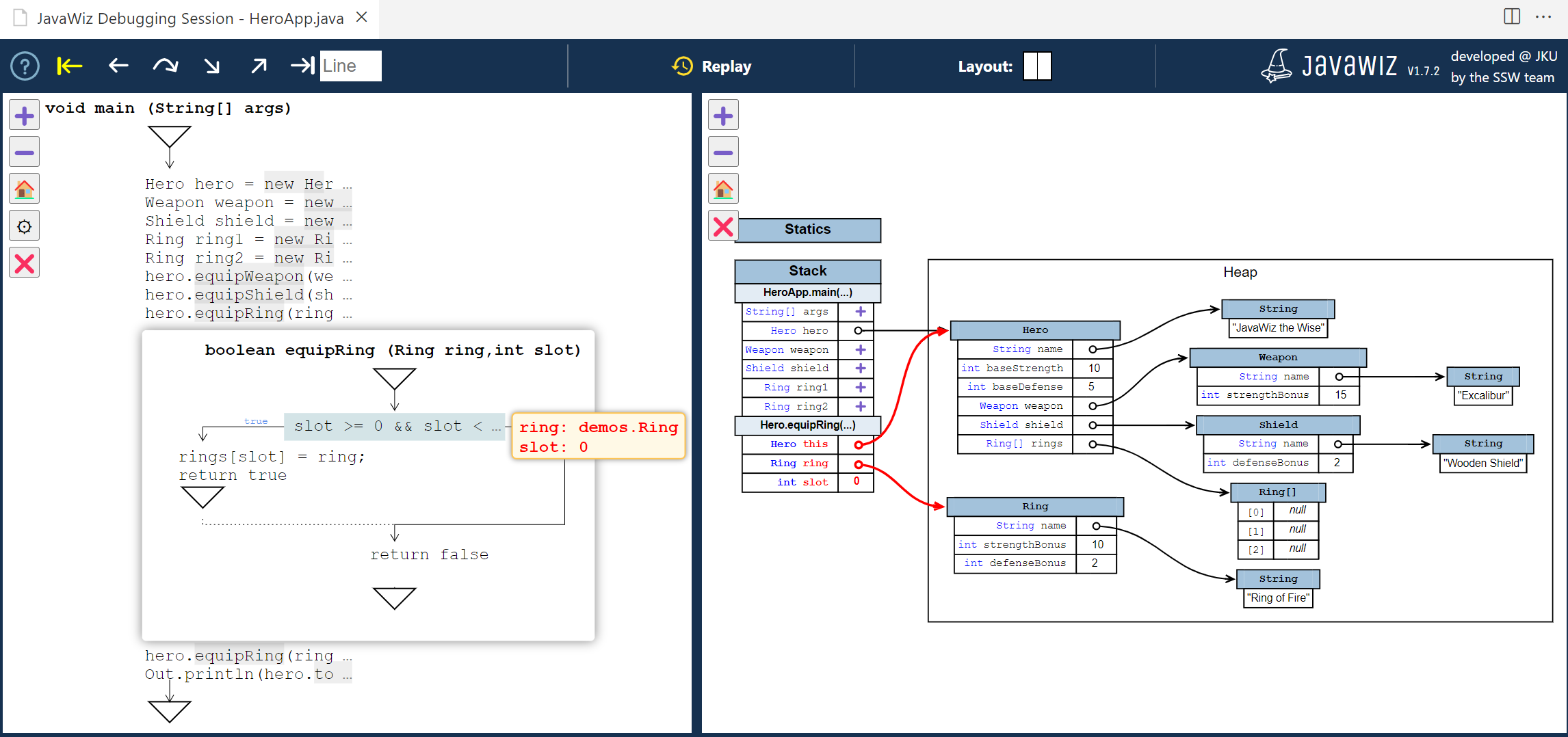
Visualize and understand your Java code execution like never before
In live sound or high-end home theaters, sound travels from different drivers (woofers and tweeters). Because these drivers are physically located in different spots, their waves can reach your ear at slightly different times, causing "phase cancellation" where certain frequencies disappear. Engineers use all-pass filters to "bend" the phase of one driver to match the other, ensuring they add together perfectly. 2. The Foundation of Phasers and Flangers
The next time you hear a perfectly aligned PA system or a lush, swirling guitar solo, you’re hearing the invisible power of phase manipulation.
This shift is most dramatic near the filter’s cutoff frequency, where the "group delay" (the actual time delay felt by the signal) is at its peak. Conclusion allpassphase
To understand all-pass phase, you first have to understand what an all-pass filter does. Mathematically, an all-pass filter has a flat magnitude response. Whether you feed it a 20Hz sub-bass or a 20kHz sizzle, the output level remains exactly the same. However, the filter introduces a .
Understanding the All-Pass Phase: The Hidden Architect of Audio Signal Processing In live sound or high-end home theaters, sound
If the volume doesn't change, why bother? All-pass phase manipulation is the "secret sauce" in several common audio scenarios: 1. Phase Alignment in Multi-Speaker Systems
The pull of the pole is perfectly balanced by the push of the zero, resulting in a gain of 1 (unity) across all frequencies. Conclusion To understand all-pass phase, you first have
Technically, an all-pass filter works by placing in a specific symmetrical relationship in the Z-plane (for digital) or S-plane (for analog).
Imagine a group of runners (frequencies) starting a race at the same time. As they pass through an all-pass filter, some runners are momentarily slowed down while others continue at full speed. They all finish the race (exit the filter) with their energy intact, but they are no longer in a straight line. This "smearing" or shifting of time relative to frequency is what we call the . Why Do We Need to Manipulate Phase?
In live sound or high-end home theaters, sound travels from different drivers (woofers and tweeters). Because these drivers are physically located in different spots, their waves can reach your ear at slightly different times, causing "phase cancellation" where certain frequencies disappear. Engineers use all-pass filters to "bend" the phase of one driver to match the other, ensuring they add together perfectly. 2. The Foundation of Phasers and Flangers
The next time you hear a perfectly aligned PA system or a lush, swirling guitar solo, you’re hearing the invisible power of phase manipulation.
This shift is most dramatic near the filter’s cutoff frequency, where the "group delay" (the actual time delay felt by the signal) is at its peak. Conclusion
To understand all-pass phase, you first have to understand what an all-pass filter does. Mathematically, an all-pass filter has a flat magnitude response. Whether you feed it a 20Hz sub-bass or a 20kHz sizzle, the output level remains exactly the same. However, the filter introduces a .
Understanding the All-Pass Phase: The Hidden Architect of Audio Signal Processing
If the volume doesn't change, why bother? All-pass phase manipulation is the "secret sauce" in several common audio scenarios: 1. Phase Alignment in Multi-Speaker Systems
The pull of the pole is perfectly balanced by the push of the zero, resulting in a gain of 1 (unity) across all frequencies.
Technically, an all-pass filter works by placing in a specific symmetrical relationship in the Z-plane (for digital) or S-plane (for analog).
Imagine a group of runners (frequencies) starting a race at the same time. As they pass through an all-pass filter, some runners are momentarily slowed down while others continue at full speed. They all finish the race (exit the filter) with their energy intact, but they are no longer in a straight line. This "smearing" or shifting of time relative to frequency is what we call the . Why Do We Need to Manipulate Phase?