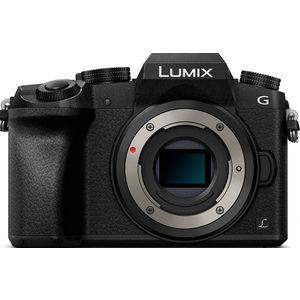
| Salida: | 19 May 2015 |
|---|---|
| Resolución: | 16Mp |
| Tecnología: | 4/3 CMOS |
| ISO: | 160-25600 |
| Peso: | 410g |
| Dimensiones: | 125 x 86 x 77 mm |
| Visor: | Electronic |
| Tipo pantalla: | 3" Fully articulated |
| Resolución video: | 3840 x 2160 |

45

42

46

62

64
Este post contiene enlaces de afiliados y seré compensado si usted hace una compra después de hacer clic a través de mis enlaces. Como Asociado de Amazon gano de las compras que califiquen.
 pros
pros contras
| reseña | comparar Panasonic Lumix DMC-G7 con | puntuación total |  Retrato |
 Paisaje |
 Deporte |
 Calle |
 Cotidiano |
|
| |
Panasonic Lumix DMC-G7 |
54 | 45 | 42 | 46 | 62 | 64 | comprar en |
|---|---|---|---|---|---|---|---|---|
 |
Sony ZV-E10 |
64 | 51 | 49 | 63 | 73 | 73 | comprar en |
As AI models become more sophisticated, the line between what is "real" and what is a "bavfake" will continue to blur. This has led to the development of "Deepfake Detection" software and the push for digital watermarking (like the C2PA standard) to verify the provenance of an image.
Many regions, including several U.S. states and EU countries, are passing laws specifically targeting the creation and distribution of non-consensual AI-generated imagery. Platforms are also being held more accountable for hosting such content. The Future of Digital Realism
The community surrounding this keyword is largely decentralized but congregates on specific image boards, private Discord servers, and specialized forums. These spaces often operate on a "request and fulfill" basis, where users ask for specific scenarios or celebrities to be "faked."
However, because much of this content borders on or explicitly crosses into adult territory (often referred to as "non-consensual deepfake pornography" or NCII), these communities frequently face de-platforming. This has led to a "cat-and-mouse" game between moderators of mainstream sites like Reddit or Twitter and the creators of this content. Ethical and Legal Concerns
Today, tools like Stable Diffusion and Midjourney allow users to generate entirely new images from text prompts, making the creation of specialized content faster and more accessible than ever before. The Community and Platforms
The most significant issue is the lack of consent. Using a person’s likeness—whether they are a public figure or a private citizen—to create explicit or misleading content is widely considered a violation of digital bodily autonomy.
"Bavfakes" is more than just a keyword; it represents a complex intersection of cutting-edge technology, fan culture, and a murky ethical landscape. As we move deeper into the age of AI, the conversations started in these fringe communities will likely shape the future of privacy and digital rights.
For the creators in these subcultures, the hobby remains a pursuit of technical perfection in digital art. For the rest of the world, it serves as a reminder to look at every digital image with a healthy dose of skepticism.
With the advent of GANs (Generative Adversarial Networks), the focus shifted to video. Users could now swap faces onto existing footage with startling accuracy.
Early creators spent hours meticulously blending layers, adjusting color balances, and hand-painting shadows to create a "fake" that could pass for "real."
As AI models become more sophisticated, the line between what is "real" and what is a "bavfake" will continue to blur. This has led to the development of "Deepfake Detection" software and the push for digital watermarking (like the C2PA standard) to verify the provenance of an image.
Many regions, including several U.S. states and EU countries, are passing laws specifically targeting the creation and distribution of non-consensual AI-generated imagery. Platforms are also being held more accountable for hosting such content. The Future of Digital Realism
The community surrounding this keyword is largely decentralized but congregates on specific image boards, private Discord servers, and specialized forums. These spaces often operate on a "request and fulfill" basis, where users ask for specific scenarios or celebrities to be "faked."
However, because much of this content borders on or explicitly crosses into adult territory (often referred to as "non-consensual deepfake pornography" or NCII), these communities frequently face de-platforming. This has led to a "cat-and-mouse" game between moderators of mainstream sites like Reddit or Twitter and the creators of this content. Ethical and Legal Concerns
Today, tools like Stable Diffusion and Midjourney allow users to generate entirely new images from text prompts, making the creation of specialized content faster and more accessible than ever before. The Community and Platforms
The most significant issue is the lack of consent. Using a person’s likeness—whether they are a public figure or a private citizen—to create explicit or misleading content is widely considered a violation of digital bodily autonomy.
"Bavfakes" is more than just a keyword; it represents a complex intersection of cutting-edge technology, fan culture, and a murky ethical landscape. As we move deeper into the age of AI, the conversations started in these fringe communities will likely shape the future of privacy and digital rights.
For the creators in these subcultures, the hobby remains a pursuit of technical perfection in digital art. For the rest of the world, it serves as a reminder to look at every digital image with a healthy dose of skepticism.
With the advent of GANs (Generative Adversarial Networks), the focus shifted to video. Users could now swap faces onto existing footage with startling accuracy.
Early creators spent hours meticulously blending layers, adjusting color balances, and hand-painting shadows to create a "fake" that could pass for "real."
Copyright 2026
EMA s.r.l.s. | p.i. 11740890014
All rights reserved
Powered by 