Originally written: 3/14/2012; last Web page update: 3/13/2020, referencing rEFInd 0.12.0
This Web page is provided free of charge and with no annoying outside ads; however, I did take time to prepare it, and Web hosting does cost money. If you find this Web page useful, please consider making a small donation to help keep this site up and running. Thanks!
| Donate $1.00 | Donate $2.50 | Donate $5.00 | Donate $10.00 | Donate $20.00 | Donate another value |
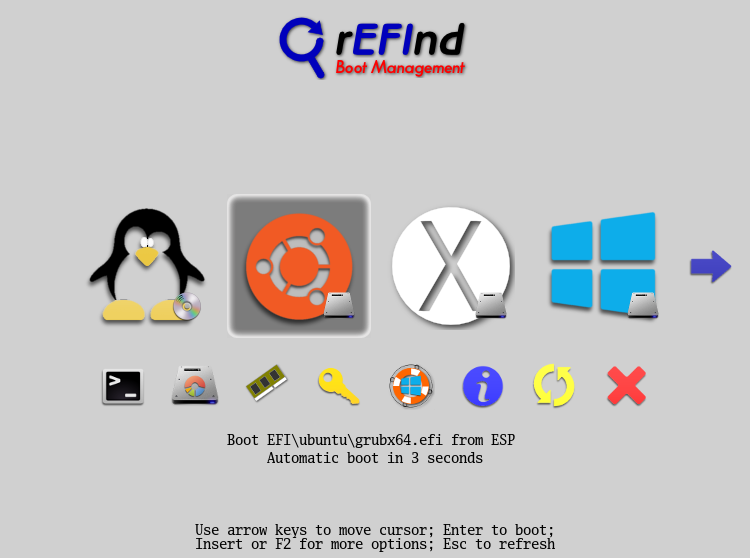
This page describes rEFInd, my fork of the rEFIt boot manager for computers based on the Extensible Firmware Interface (EFI) and Unified EFI (UEFI). Like rEFIt, rEFInd is a boot manager, meaning that it presents a menu of options to the user when the computer first starts up, as shown below. rEFInd is not a boot loader, which is a program that loads an OS kernel and hands off control to it. (Since version 3.3.0, the Linux kernel has included a built-in boot loader, though, so this distinction is rather artificial these days, at least for Linux.) Many popular boot managers, such as the Grand Unified Bootloader (GRUB), are also boot loaders, which can blur the distinction in many users' minds. All EFI-capable OSes include boot loaders, so this limitation isn't a problem. If you're using Linux, you should be aware that several EFI boot loaders are available, so choosing between them can be a challenge. In fact, the Linux kernel can function as an EFI boot loader for itself, which gives rEFInd characteristics similar to a boot loader for Linux. See my Web page on this topic for more information.
By the 1970s and 80s, documentaries began focusing on the grueling reality of production. Notable examples include Hearts of Darkness: A Filmmaker's Apocalypse (1991), which chronicled the chaotic production of Apocalypse Now , and Burden of Dreams (1982), which followed Werner Herzog's obsessive struggle to film in the Amazon.
Documentaries focused on the entertainment industry serve as a "meta" exploration of culture, peeling back the layers of glamour to reveal the technical, political, and personal machinery behind the scenes. From chronicling the legendary "dream factories" of early Hollywood to exposing systemic issues like gender discrimination in the modern era, these films act as both historical archives and catalysts for industry-wide change. 1. The Evolution of Industry Documentaries girlsdoporn 18 years old e392 05112016 work
Failed or notoriously difficult film projects and the visionaries behind them. Lucy and Desi (2022), Listen to Me Marlon (2015) By the 1970s and 80s, documentaries began focusing
Exploring the video game industry or the adult entertainment business. From chronicling the legendary "dream factories" of early
The art of cinematography, editing, and the unsung heroes behind the camera. This Changes Everything (2018), The Celluloid Closet (1995)
The Lens on the Limelight: How Entertainment Industry Documentaries Shape Our Cultural Perspective
Issues of gender discrimination, LGBTQ+ representation, and systemic bias. From Bedrooms to Billions (2014), After Porn Ends (2012)
copyright © 2012–2020 by Roderick W. Smith
This document is licensed under the terms of the GNU Free Documentation License (FDL), version 1.3.
If you have problems with or comments about this Web page, please e-mail me at Thanks.
Return to my main Web page.